
| Application times (◆ optimal, ◇ optional): | Direction for use: |
| ◆ Autumn: 3–6 leaves unfolded | 2–5 kg/ha |
| ◆ Spring: tillering | 2–5 kg/ha |
| ◇/◆ stem elongation The application time should be considered as optimal when varieties with high demand for phosphorus are grown and in conditions of poor phosphorus uptake from the soil (e.g. low phosphorus content in the soil, periodic water deficiency, soil pH below 6.5 or above 7.0) as well as in order to increase efficiency of kernel formation.<*/small> |
2–5 kg/ha |
| ◆ flag leaf stage / beginning of heading | 2–5 kg/ha |
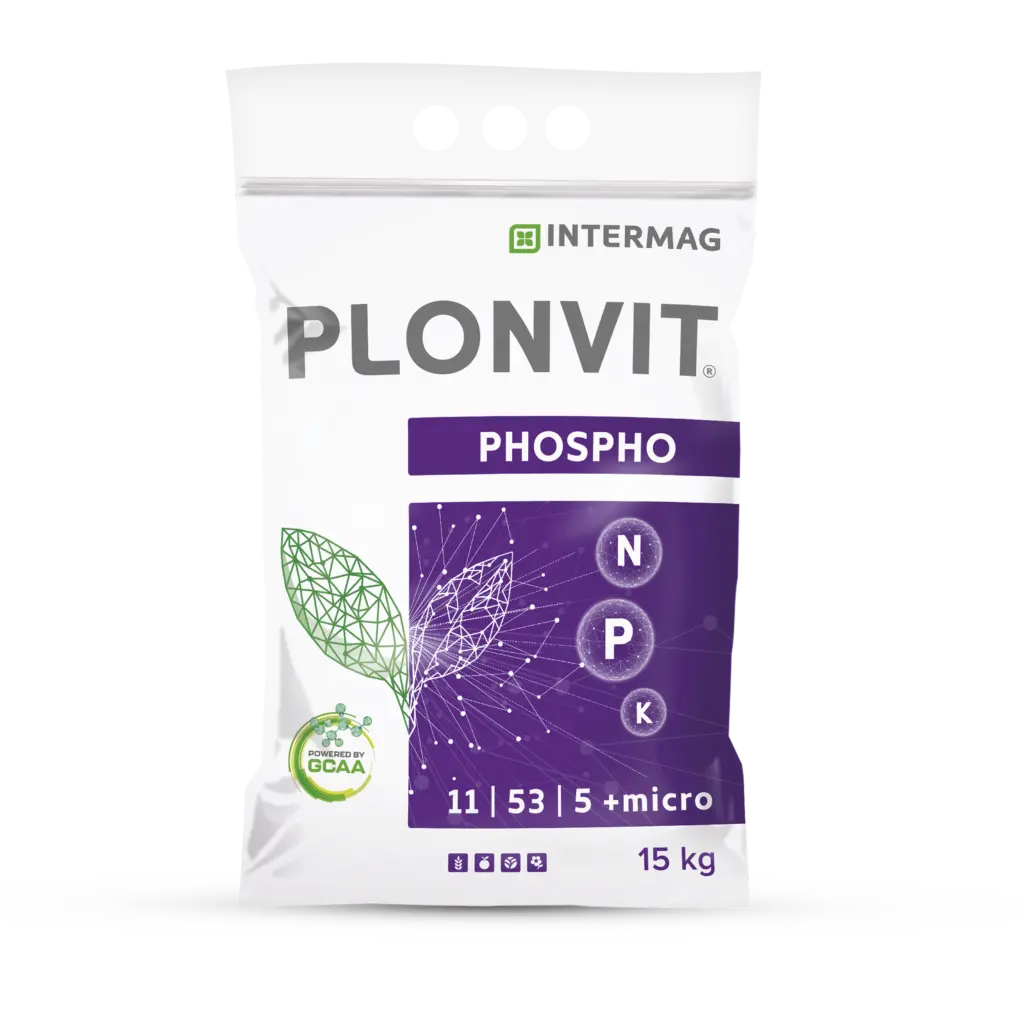
PLONVIT® PHOSPHO
Crystalline, water-soluble NPK foliar fertiliser with high concentration of nutrients, with majority of phosphorus
DESCRIPTION
PLONVIT® PHOSPHO is a crystalline, water-soluble NPK (11/53/5) fertiliser with micronutrients intended for foliar application. It can also be used to prepare a nutrient solution for fertigation of crops in the ground.
PLONVIT® PHOSPHO effectively nourishes plants, supports proper development of the root system and its regeneration, has a positive effect on flowering and development of generative organs. It is particularly recommended during periods of increased plant demand for phosphorus – during the preparation of plants for winter dormancy, during periods of low temperatures, as well as on acidic and alkaline soils.
PLONVIT® PHOSPHO applied at the times and doses recommended in foliar feeding programs for individual plant species, effectively supplements and/or corrects soil fertilisation.
PLONVIT® PHOSPHO contains patented GCAA technology, which combines microelements with the amino acid glycine. Glycine is the smallest and most mobile amino acid in plants. As a result, micro-nutrients bound to glycine deliver nutrients more quickly and effectively than mineral salts, oxides or fertilisers based on other complexing agents.
| Nutrients | g/kg | % (m/m) |
| Total nitrogen (N) | 110 | 11.0 |
| Nitrogen (N) ammonium(NH4) | 92 | 9.2 |
| Nitrogen (N) urea (NH2) | 18 | 1.8 |
| Phosphorus pentoxide (P2O5) total | 530 | 53.0 |
| Phosphorus pentoxide (P2O5) soluble in water | 530 | 53.0 |
| Phosphorus pentoxide (P2O5) soluble in neutral ammonium citrate solution | 530 | 53.0 |
| Potassium oxide (K2O) soluble in water | 50 | 5.0 |
| Boron (B) in the form of sodium salt | 0.3 | 0.03 |
| Copper (Cu) as glycinate | 0.3 | 0.03 |
| Iron (Fe) chelated by EDTA | 1.5 | 0.15 |
| Manganese (Mn) as glyciniate | 0.70 | 0.07 |
| Molybdenum (Mo) in the form of ammonium salt | 0.02 | 0.002 |
| Zinc (Zn) as glycinate | 0.7 | 0.07 |
Additional Information
| Application times (◆ optimal, ◇ optional): | Direction for use: |
| ◆ leaf development – tillering | 2–5 kg/ha |
| ◇/◆ stem elongation The application time should be considered as optimal when varieties with high demand for phosphorus are grown and in conditions of poor phosphorus uptake from the soil (e.g. low phosphorus content in the soil, periodic water deficiency, soil pH below 6.5 or above 7.0) as well as in order to increase efficiency of kernel formation. |
2–5 kg/ha |
| ◆ flag leaf stage / beginning of heading | 2–5 kg/ha |
| Application times (◆ optimal, ◇ optional): | Direction for use: |
| ◆ Autumn: 3–6 leaves unfolded | 2–5 kg/ha |
| ◆ Spring: continuation of tillering | 2–5 kg/ha |
| ◇/◆ stem elongation The application time should be considered as optimal when varieties with high demand for phosphorus are grown and in conditions of poor phosphorus uptake from the soil (e.g. low phosphorus content in the soil, periodic water deficiency, soil pH below 6.5 or above 7.0) as well as in order to increase efficiency of kernel formation. |
2–5 kg/ha |
| ◇ flag leaf stage / beginning of heading | 2–5 kg/ha |
| Application times (◆ optimal, ◇ optional): | Direction for use: |
| ◆ leaf development – tillering | 2–5 kg/ha |
| ◇/◆ stem elongation The application time should be considered as optimal when varieties with high demand for phosphorus are grown and in conditions of poor phosphorus uptake from the soil (e.g. low phosphorus content in the soil, periodic water deficiency, soil pH below 6.5 or above 7.0) as well as in order to increase efficiency of kernel formation. |
2–5 kg/ha |
| ◇ flag leaf stage / beginning of heading | 2–5 kg/ha |
| Application times (◆ optimal, ◇ optional): | Direction for use: |
| ◆ Autumn: leaf development – until beginning of tillering | 2–5 kg/ha |
| ◆ Spring: beginning of stem elongation | 2–5 kg/ha |
| ◆ flag leaf stage – until first awns visible | 2–5 kg/ha |
| ◇ end of flowering – until medium milk stage of grain ripening | 2–5 kg/ha |
| Application times (◆ optimal, ◇ optional): | Direction for use: |
| ◆ leaf development – until beginning of stem elongation | 2–5 kg/ha |
| ◆ flag leaf stage – until first awns visible | 2–5 kg/ha |
| ◇ end of flowering – until medium milk maturity of grains | 2–5 kg/ha |
| Application times (◆ optimal, ◇ optional): | Direction for use: |
| ◆ Autumn: leaf development – until beginning of tillering | 2–5 kg/ha |
| ◆ Spring: beginning of stem elongation | 2–5 kg/ha |
| ◆ flag leaf stage – until first awns visible | 2–5 kg/ha |
| ◇ end of flowering – until medium milk stage of grain ripening | 2–5 kg/ha |
| Application times (◆ optimal, ◇ optional): | Direction for use: |
| ◆ leaf development – until beginning of stem elongation | 2–5 kg/ha |
| ◆ flag leaf stage – until first awns visible | 2–5 kg/ha |
| ◇ end of flowering – until medium milk maturity of grains | 2–5 kg/ha |
| Application times (◆ optimal, ◇ optional): | Direction for use: |
| ◆ Autumn: leaf development – until beginning of tillering | 2–5 kg/ha |
| ◆ Spring: beginning of stem elongation | 2–5 kg/ha |
| ◇/◆ flag leaf stage – until beginning of heading The treatment should be considered as optimal when varieties with high demand for phosphorus are grown and in conditions of poor phosphorus uptake from the soil (e.g. low phosphorus content in the soil, periodic water deficiency, soil pH below 6,5 or above 7.0) as well as in order to increase efficiency of kernel formation. |
2–5 kg/ha |
| ◇ end of flowering – until early milk | 2–5 kg/ha |
| Application times (◆ optimal, ◇ optional): | Direction for use: |
| ◇ leaf development – until beginning of stem elongation | 2–5 kg/ha |
| ◇/◆ flag leaf stage – until beginning of heading The treatment should be considered as optimal when varieties with high demand for phosphorus are grown and in conditions of poor phosphorus uptake from the soil (e.g. low phosphorus content in the soil, periodic water deficiency, soil pH below 6,5 or above 7.0) as well as in order to increase efficiency of kernel formation. |
2–5 kg/ha |
| ◇ end of flowering – until early milk | 2–5 kg/ha |
| Application times (◆ optimal, ◇ optional): | Direction for use: |
| ◆ leaf development – tillering The treatment should be considered as optimal when varieties with high demand for phosphorus are grown and in conditions of poor phosphorus uptake from the soil (e.g. low phosphorus content in the soil, periodic water deficiency, soil pH below 6,5 or above 7.0). |
2–5 kg/ha |
| ◇ stem elongation – until flag leaf stage | 2–5 kg/ha |
| ◇ end of flowering – until early milk | 2–5 kg/ha |
| Application times (◆ optimal, ◇ optional): | Direction for use: |
| Autumn: ◆ 4–8 leaves unfolded |
2–5 kg/ha |
| Spring: ◆ beginning of main stem elongation |
2–5 kg/ha |
| ◆ bud formation – until beginning of flowering: 1–2 treatments every 5–10 days | 2–5 kg/ha |
| ◆ from the beginning of petal fall – until the beginning of pods development | 2–5 kg/ha |
| Application times (◆ optimal, ◇ optional): | Direction for use: |
| ◆ leaf development – until beginning of main stem elongation | 2–5 kg/ha |
| ◆ bud formation – until beginning of flowering: 1–2 treatments every 5–10 days | 2–5 kg/ha |
| ◆ from the beginning of petal fall – until the beginning of pods development | 2–5 kg/ha |
</tr
| Application times (◆ optimal, ◇ optional): | Direction for use: |
| ◆ 2–3 pairs of leaves (BBCH 14–16) | 2–5 kg/ha |
| ◇ beginning of stem elongation (BBCH 30–33) | 2–5 kg/ha |
| Application times (◆ optimal, ◇ optional): | Direction for use: |
| ◇ leaf development on the main stem (BBCH 12–14) | 2–5 kg/ha |
| ◆ stem growth (BBCH 30–35) | 2–5 kg/ha |
| Application times (◆ optimal, ◇ optional): | Direction for use: |
| ◆ 2–6 leaves unfolded (4 leaves is the optimum stage for treatment) | 2–5 kg/ha |
| ◆ 7–8 leaves unfolded | 2–5 kg/ha |
| ◆ stem elongation – until beginning of tassel formation | 2–5 kg/ha |
| Application times (◆ optimal, ◇ optional): | Direction for use: |
| ◆ beginning of leaf development | 2–5 kg/ha |
| ◇/◆ beginning of crop cover The treatment should be considered as optimal in the case of limited phosphorus uptake from soil (e.g. low phosphorus content in soil, low temperature, periodic water shortages, soil pH below 6.5 or above 7.0). |
2–5 kg/ha |
| ◇ beginning of storage root development | 2–5 kg/ha |
| Application times (◆ optimal, ◇ optional): | Direction for use: |
| ◆ beginning of growth of shoots and leaves (plant height about 10 cm) | 2–5 kg/ha |
| ◆ growth of shoots and leaves (plant height ˃15 cm) | 2–5 kg/ha |
| ◇/◆ beginning of tuber formation: 1–2 treatments every 5–7 days The treatment should be considered as optimal in case of poorly tuber setting. |
2–5 kg/ha |
| ◇ beginning of tuber growth | 2–5 kg/ha |
| ◇ tuber growth: 1–3 treatments every 14–21 days | 2–5 kg/ha |
| Application times (◆ optimal, ◇ optional): | Direction for use: |
| ◇ after emergence | 2–5 kg/ha |
| ◆ first trifoliate leaf development | 2–5 kg/ha |
| ◆ beginning of flower bud development | 2–5 kg/ha |
| ◇/◆ beginning of pod and seed development The application time should be considered as optimal in case of difficult growing conditions (incorrect pH, poor nodulation). |
2–5 kg/ha |
| Application times (◆ optimal, ◇ optional): | Direction for use: |
| ◇ after emergence | 2–5 kg/ha |
| ◆ first true leaf development | 2–5 kg/ha |
| ◆ beginning of flower bud development | 2–5 kg/ha |
| ◇/◆ beginning of pod and seed development The application time should be considered as optimal in case of difficult growing conditions (incorrect pH, poor nodulation). |
2–5 kg/ha |
| Application times (◆ optimal, ◇ optional): | Direction for use: |
| ◇ after emergence | 2–5 kg/ha |
| ◆ first true leaf development | 2–5 kg/ha |
| ◆ beginning of flower bud development | 2–5 kg/ha |
| ◇/◆ beginning of pod and seed development The application time should be considered as optimal in case of difficult growing conditions (incorrect pH, poor nodulation). |
2–5 kg/ha |
| Application times (◆ optimal, ◇ optional): | Direction for use: |
| ◇ after emergence | 2–5 kg/ha |
| ◆ first true leaf development | 2–5 kg/ha |
| ◆ beginning of flower bud development | 2–5 kg/ha |
| ◇/◆ beginning of pod and seed development The application time should be considered as optimal in case of difficult growing conditions (incorrect pH, poor nodulation). |
2–5 kg/ha |
| Application times (◆ optimal, ◇ optional): | Direction for use: |
| ◇ after emergence | 2–5 kg/ha |
| ◆ first true leaf development | 2–5 kg/ha |
| ◆ beginning of flower bud development | 2–5 kg/ha |
| ◇/◆ beginning of pod and seed development The application time should be considered as optimal in case of difficult growing conditions (incorrect pH, poor nodulation). |
2–5 kg/ha |
| Application times (◆ optimal, ◇ optional): | Direction for use: |
| ◇ after emergence | 2–5 kg/ha |
| ◆ first true leaf development | 2–5 kg/ha |
| ◆ beginning of flower bud development | 2–5 kg/ha |
| ◇/◆ beginning of pod and seed development The application time should be considered as optimal in case of difficult growing conditions (incorrect pH, poor nodulation). |
2–5 kg/ha |
| Application times (◆ optimal, ◇ optional): | Direction for use: |
| ◇ after emergence | 2–5 kg/ha |
| ◆ first true leaf development | 2–5 kg/ha |
| ◆ beginning of flower bud development | 2–5 kg/ha |
| ◇/◆ beginning of pod and seed development The application time should be considered as optimal in case of difficult growing conditions (incorrect pH, poor nodulation). |
2–5 kg/ha |
| Application times (◆ optimal, ◇ optional): | Direction for use: |
| ◇ after emergence | 2–5 kg/ha |
| ◆ first true leaf development | 2–5 kg/ha |
| ◆ beginning of flower bud development | 2–5 kg/ha |
| ◇/◆ beginning of pod and seed development The application time should be considered as optimal in case of difficult growing conditions (incorrect pH, poor nodulation). |
2–5 kg/ha |
| Application times (◆ optimal, ◇ optional): | Direction for use: |
| ◇ after emergence | 2–5 kg/ha |
| ◆ rosette development | 2–5 kg/ha |
| ◆ beginning of flower bud development | 2–5 kg/ha |
| ◇/◆ beginning of pod and seed development The application time should be considered as optimal in case of difficult growing conditions (incorrect pH, poor nodulation). |
2–5 kg/ha |
| Application times (◆ optimal, ◇ optional): | Direction for use: |
| ◆ 3–6 leaves (BBCH 13–16) | 2–5 kg/ha |
| ◆ beginning of tillering until beginning of stem elongation (BBCH 21–32) | 2–5 kg/ha |
| ◇ stem elongation until beginning of tassel formation (BBCH 31–51) | 2–5 kg/ha |
| Application times (◆ optimal, ◇ optional): | Direction for use: |
| ◆ leaf development (BBCH 13–19) | 2–5 kg/ha |
| ◆ beginning of stem elongation (BBCH 31–33) | 2–5 kg/ha |
| ◇ stem elongation until beginning of tassel development (BBCH 35–51) | 2–5 kg/ha |
| Application times (◆ optimal, ◇ optional): | Direction for use: |
| ◆ leaf development – tillering | 2–5 kg/ha |
| ◆ beginning of stem formation | 2–5 kg/ha |
| ◇ beginning of panicle emergence | 2–5 kg/ha |
| Application times (◆ optimal, ◇ optional): | Direction for use: |
| ◆ beginning of leaf development | 2–5 kg/ha |
| ◇/◆ beginning of side shoots formation The treatment should be considered as optimal when plants are grown on alkaline soils and/or with a high zinc (Zn) content in soil. |
2–5 kg/ha |
| ◆ beginning of flower bud development | 2–5 kg/ha |
| Application times for foliar treatments (◆ optimal, ◇ optional): | Direction for use: |
| ◇ green bud stage | Foliar treatments – single dose 2-5 kg/ha. |
| ◆ pink bud stage | |
| ◆ end of flowering: majority of petals fallen | |
| ◆ beginning of fruit development | |
| ◇ fruit reaches 30–50% of typical size | |
| ◆ beginning of fruit ripening: 1–2 treatments every 5–7 days | |
| ◇/◆ after harvest The application time should be considered as optimal in case of poor condition of trees after fruit harvest. |
| Application times for foliar treatments (◆ optimal, ◇ optional): | Direction for use: |
| ◇ green bud stage | Foliar treatments – single dose 2-5 kg/ha. |
| ◇/◆ pink bud stage The application time should be considered as optimal in case of of low soil temperature in early spring (<12°C). |
|
| ◆ beginning of fruit development | |
| ◆ beginning of fruit ripening: 1–2 treatments every 5–7 days | |
| ◇/◆ after harvest The application time should be considered as optimal in case of poor condition of trees after fruit harvest. |
| Application times for foliar treatments (◆ optimal, ◇ optional): | Direction for use: |
| ◆ Spring: leaf development | Foliar treatments – single dose 2-5 kg/ha. |
| ◆ Spring/summer: growth of main stem and side shoots |
| Application times for foliar treatments (◆ optimal, ◇ optional): | Direction for use: |
| ◆ 1st year – spring (after plant adaptation in the field): beginning of leaf development | Foliar treatments – single dose 2-5 kg/ha. |
| ◆ 1st year – summer (about 3–4 weeks after budding): end of shoot and leaf growth | |
| ◆ 2nd year – spring (after cutting the rootstock above the budding place): beginning of shoot and leaf development | |
| ◆ 2nd year – spring/summer: growth of main stem and side shoots |
| Application times for foliar treatments (◆ optimal, ◇ optional): | Direction for use: |
| ◆ 1st year – spring (after plant adaptation in the field): beginning of shoot and leaf development | Foliar treatments – single dose 2-5 kg/ha. |
| ◆ 1st year – summer: growth of main stem and leaf development | |
| ◆ 2nd year – spring (10–14 days after cutting the main stem at a height of approx. 60–65 cm.): beginning of shoot and leaf development | |
| ◆ 2nd year – spring/summer: growth of main stem and side shoot |
| Application times for foliar treatments (◆ optimal, ◇ optional): | Direction for use: |
| ◇ green bud stage | Foliar treatments – single dose 2–5 kg/ha |
| ◆ white bud stage | |
| ◆ end of flowering: majority of petals fallen | |
| ◆ beginning of fruit development | |
| ◇ fruit reaches 30–50% of typical size | |
| ◇/◆ beginning of maturation: 1–2 treatments every 5–7 days The treatment should be considered as optimal in case of varieties with the red skin. |
|
| ◇/◆ after harvest The treatment should be considered as optimal in case of poor condition of trees after fruit harvest. |
| Application times for foliar treatments (◆ optimal, ◇ optional): | Direction for use: |
| ◇ inflorescence emergence | Foliar treatments – single dose 2-5 kg/ha. |
| ◆ end of flowering / beginning of leaf development | |
| ◆ the fruit reaches about half of final size | |
| ◇/◆ the fruit reaches 80-90% of final size
The application time should be considered as optimal in the case of the need to increase the ripening rate of the fruit and in the case of the cultivation of sweet cherry varieties with dark red fruit color. |
|
| ◇ after harvest: 1–2 treatments every 10–14 days |
| Application times for foliar treatments (◆ optimal, ◇ optional): | Direction for use: |
| ◇/◆ the fruit reaches about half of final size The treatment should be considered as optimal in case of unfavorable conditions for phosphorus uptake from the soil. |
Foliar treatments – single dose 2–5 kg/ha |
| ◇/◆ the fruit reaches 80-90% of final size The application time should be considered as optimal in the case of the need to increase the ripening rate of the fruit and in the case of the cultivation of sweet cherry varieties with dark red fruit color. |
|
| ◇ after harvest: 1–2 treatments every 10–14 days |
| Application times for foliar treatments (◆ optimal, ◇ optional): | Direction for use: |
| ◇ inflorescence emergence | Foliar treatments – single dose 2–5 kg/ha |
| ◆ end of flowering / beginning of leaf development | |
| ◆ the fruit reaches about half of final size | |
| ◆ the fruit reaches 80-90% of final size | |
| ◇ after harvest: 1–2 treatments every 10–14 days |
| Application times for foliar treatments (◆ optimal, ◇ optional): | Direction for use: |
| ◇/◆ the fruit reaches about half of final size The treatment should be considered as optimal in case of unfavorable conditions for phosphorus uptake from the soil. |
Foliar treatments – single dose 2–5 kg/ha |
| ◆ the fruit reaches 80-90% of final size | |
| ◇ after harvest: 1–2 treatments every 10–14 days |
| Application times for foliar treatments (◆ optimal, ◇ optional): | Direction for use: |
| ◇ inflorescence emergence | Foliar treatments – single dose 2-5 kg/ha |
| ◆ end of flowering / beginning of leaf development | |
| ◆ fruitlet development | |
| ◆ the fruit reaches about 30% of final size | |
| ◆ the fruit reaches about half of final size | |
| ◇/◆ the fruit reaches 80–90% of final size The treatment should be considered as optimal in case of cultivating varieties with dark fruit color. |
|
| ◇ after harvest |
| Application times for foliar treatments (◆ optimal, ◇ optional): | Direction for use: |
| ◇ inflorescence emergence | Foliar treatments – single dose 2-5 kg/ha |
| ◆ end of flowering / beginning of leaf development | |
| ◆ fruitlet development | |
| ◆ the fruit reaches about 30% of final size | |
| ◆ the fruit reaches about half of final size | |
| ◇ the fruit reaches 80–90% of final size | |
| ◇ after harvest |
| Application times for foliar treatments (◆ optimal, ◇ optional): | Direction for use: |
| ◇ inflorescence emergence | Foliar treatments – single dose 2-5 kg/ha |
| ◆ end of flowering / beginning of leaf development | |
| ◆ fruitlet development | |
| ◆ the fruit reaches about 30% of final size | |
| ◆ the fruit reaches about half of final size | |
| ◇ the fruit reaches 80–90% of final size | |
| ◇ after harvest |
| Application times for foliar treatments (◆ optimal, ◇ optional): | Direction for use: |
| ◇ inflorescence emergence | Foliar treatments – single dose 2-5 kg/ha |
| ◆ end of flowering / beginning of leaf development | |
| ◆ fruitlet development | |
| ◆ the fruit reaches about 30% of final size | |
| ◆ the fruit reaches about half of final size | |
| ◇ the fruit reaches 80–90% of final size | |
| ◇ after harvest |
| Application times (◆ optimal, ◇ optional): | Direction for use: |
| ◇ sprouting / bud development | 2–5 kg/ha |
| ◆ first new leaves visible | 2–5 kg/ha |
| ◆ beginning of flower bud development | 2–5 kg/ha |
| ◆ beginning of fruit development | 2–5 kg/ha |
| ◆ beginning of fruit colouring | 2–5 kg/ha |
| ◆ post-harvest | 2–5 kg/ha |
| Application times (◆ optimal, ◇ optional): | Direction for use: |
| ◆ new shoot development | 2–5 kg/ha |
| ◇ beginning of flowering | 2–5 kg/ha |
| ◆ fruit set | 2–5 kg/ha |
| ◆ beginning of fruit development | 2–5 kg/ha |
| ◆ beginning of fruit coloration – picking of green olives | 2–5 kg/ha |
| ◆ beginning of maturation | 2–5 kg/ha |
| ◇ post-harvest | 2–5 kg/ha |
| Application times (◆ optimal, ◇ optional): | Direction for use: |
| ◆ leaf and shoot development | 2–5 kg/ha |
| ◆ inflorescence development | 2–5 kg/ha |
| ◆ pinhead | 2–5 kg/ha |
| ◆ intensive growth of fruit | 2–5 kg/ha |
| ◆ post-harvest | 2–5 kg/ha |
| Application times (◆ optimal, ◇ optional): | Direction for use: |
| ◇ bud development (BBCH 51–53) | 2–5 kg/ha |
| ◆ petals falling until end of flowering (BBCH 67–69) | 2–5 kg/ha |
| ◆ fruit development (BBCH 71–75) | 2–5 kg/ha |
| Application times (◆ optimal, ◇ optional): | Direction for use: |
| ◇ bud development (BBCH 51–53) | 2–5 kg/ha |
| ◆ petals falling until end of flowering (BBCH 67–69) | 2–5 kg/ha |
| ◆ fruit development (BBCH 71–75) | 2–5 kg/ha |
| Application times (◆ optimal, ◇ optional): | Direction for use: |
| ◇ bud development (BBCH 51–53) | 2–5 kg/ha |
| ◆ petals falling until end of flowering (BBCH 67–69) | 2–5 kg/ha |
| ◆ fruit development (BBCH 71–75) | 2–5 kg/ha |
| Application times (◆ optimal, ◇ optional): | Direction for use: |
| ◆ Spring: after start of growing season – bud burst | Foliar treatments – single dose 2–5 kg/ha |
| ◆ leaf development – until beginning of inflorescence emergence | |
| ◆ immediately after harvest |
Plantations without fertigation
| Application times for foliar treatments (◆ optimal, ◇ optional): | Direction for use: |
| ◆ Spring: after start of growing season | Foliar treatments – single dose 2–5 kg/ha |
| ◆ leaf and shoot growth: 1–2 treatments every 21–28 days | |
| ◆ beginning of the first inflorescence emergence | |
| ◆ beginning of flowering | |
| ◆ beginning of the first fruit development | |
| ◆ growth and ripening of fruits: 1–2 treatments between successive harvests every 14–21 days |
Fertigated plantations
| Application times for foliar treatments (◆ optimal, ◇ optional): | Direction for use: |
| ◆ Spring: after start of growing season – leaf development | Foliar treatments – single dose 2–5 kg/ha |
| ◇/◆ leaf and shoot growth: 1–2 treatments every 21–28 days The application time should be considered as optimal if fertigation is not an available option. |
Plantations without fertigation
| Application times for foliar treatments (◆ optimal, ◇ optional): | Direction for use: |
| ◆ leaf and shoot growth: 1–2 treatments every 10–14 days | Foliar treatments – single dose 2–5 kg/ha |
| ◆ beginning of inflorescence emergence | |
| ◆ beginning of flowering | |
| ◆ beginning of fruit development | |
| ◆ growth and ripening of fruits: 1–2 treatments between harvests every 14–21 days | |
| ◇ immediately after harvest |
Fertigated plantations
| Application times for foliar treatments (◆ optimal, ◇ optional): | Direction for use: |
| ◇/◆ leaf and shoot growth: 1–2 treatments every 10–14 days The application time should be considered as optimal if fertigation is not an available option. | Foliar treatments – single dose 2–5 kg/ha |
| ◇ immediately after harvest |
| Application times for foliar treatments(◆ optimal, ◇ optional): | Direction for use: |
| ◆ leaf and shoot development: 1–2 treatments every 10–14 days | Foliar treatments single dose 2–5 kg/ha |
| ◆ beginning of inflorescence emergence | |
| ◆ beginning of flowering | |
| ◇ growth of fruits: 1–2 treatments every 5–14 days | |
| ◇ after harvest: 1–2 treatments every 10–21 days |
| Application times for foliar treatments (◆ optimal, ◇ optional): | Direction for use: |
| ◆/◇ leaf and shoot development: 1–2 treatments every 10–14 days. The application time should be considered as optimal if fertigation is not an available option. | Foliar treatments – single dose 2–5 kg/ha. |
| ◇ after harvest: 1–2 treatments every 10–21 days |
| Application times for foliar treatments (◆ optimal, ◇ optional): | Direction for use: |
| ◇ bud development | Foliar treatments – single dose 2–5 kg/ha |
| ◆ beginning of leaf development and inflorescence emergence | |
| ◇ inflorescence emergence until beginning of flowering | |
| ◆ end of flowering / beginning of fruit development | |
| ◆ fruit development and maturation: 2 treatments every 10–14 days | |
| ◇ post-harvest |
| Application times (◆ optimal, ◇ optional): | Direction for use: |
| ◆ beginning of leaf and new shoot development | 2–5 kg/ha |
| ◆ inflorescence emergence | 2–5 kg/ha |
| ◇ end of flowering | 2–5 kg/ha |
| ◆ fruit development – until berries pea-sized | 2–5 kg/ha |
| Application times (◆ optimal, ◇ optional): | Direction for use: |
| ◇ leaf development | Foliar treatments – single dose 2–5 kg/ha |
| ◆ beginning of inflorescence emergence | |
| ◆ beginning of flowering | |
| ◆ beginning of fruit development: 2 treatments every 5–10 days | |
| ◆ post-harvest – when plants are leaving for the next growing season: 1–2 treatments every 10–21 days |
| Application times (◆ optimal, ◇ optional): | Direction for use: |
| ◆ Autumn in the planting year: before beginning of leaf colour turning | 2–5 kg/ha |
| ◆ Spring: leaf development | 2–5 kg/ha |
| ◆ Spring: beginning of runner growth | 2–5 kg/ha |
| ◆ Beginning of summer: elongation growth of runners and rosette plantlets set on the runners | 2–5 kg/ha |
| ◆ Summer: development, growth and rooting of plantlets | 2–5 kg/ha |
| Application times (◆ optimal, ◇ optional): | Direction for use: |
| ◆ FIELD GROWN NURSERY PLANTATIONS – autumn in the planting year: before beginning of leaf colour turning | 2–5 kg/ha |
| ◆ FIELD GROWN NURSERY PLANTATIONS – spring: leaf development | 2–5 kg/ha |
| ◆ FIELD GROWN NURSERY PLANTATIONS – spring: beginning of runner growth | 2–5 kg/ha |
| ◆ FIELD GROWN NURSERY PLANTATIONS – beginning of summer: elongation growth of runners and rosette plantlets set on the runners | 2–5 kg/ha |
| ◇ GREEN POTTED PLANTLETS: 2nd–3rd day after planting of cuttings | 2–5 kg/ha |
| ◆ GREEN POTTED PLANTLETS: 5th–7th day after planting of cuttings | 2–5 kg/ha |
| ◇ GREEN POTTED PLANTLETS: 14th–21st day after planting of cuttings | 2–5 kg/ha |
| Application times (◆ optimal, ◇ optional): | Direction for use: |
| ◆ Autumn in the planting year: before beginning of leaf colour turning | 2–5 kg/ha |
| ◆ Spring: leaf development | 2–5 kg/ha |
| ◆ Spring: beginning of runner growth | 2–5 kg/ha |
| ◆ Beginning of summer: elongation growth of runners and rosette plantlets set on the runners | 2–5 kg/ha |
| ◆ Summer: development, growth and rooting of plantlets | 2–5 kg/ha |
| Application times for foliar treatments (◆ optimal, ◇ optional): | Direction for use: |
| ◆ after seedling adaptation to the field conditions | Foliar treatments – single dose 2–5 kg/ha. |
| ◇/◆ intensive plant growth: 1–2 treatments every 5–7 days The application time should be considered as optimal when varieties with high demand for phosphorus are grown and also in conditions of poor phosphorus uptake from the soil (e.g. low phosphorus content in the soil, periodic water deficiency, soil pH below 6,0 or above 7.0). |
|
| ◆ beginning of inflorescence emergence | |
| ◆ beginning of flowering | |
| ◇ fruit development | |
| ◇/◆ full yielding: 1–2 treatments every 7–21 days The application time should be considered as optimal when varieties with high demand for phosphorus are grown and also in conditions of poor phosphorus uptake from the soil (e.g. low phosphorus content in the soil, periodic water deficiency, soil pH below 6,0 or above 7.0). |
| Application times for foliar treatments (◆ optimal, ◇ optional): | Direction for use: |
| ◇ after seedling adaptation to the field conditions | Foliar treatments – single dose 2–5 kg/ha. |
| ◇/◆ intensive plant growth: 1–2 treatments every 5–7 days The application time should be considered as optimal when varieties with high demand for phosphorus are grown and also in conditions of poor phosphorus uptake from the soil (e.g. low phosphorus content in the soil, periodic water deficiency, soil pH below 6,0 or above 7.0). |
|
| ◆ the inflorescence emergence – beginning of flowering | |
| ◇ fruit development | |
| ◇ full yielding: 1–2 treatments every 7–21 days |
| Application times for foliar treatments (◆ optimal, ◇ optional): | Direction for use: |
| ◇ after seedling adaptation to the field conditions | Foliar treatments – single dose 2–5 kg/ha. |
| ◇/◆ intensive plant growth: 1–2 treatments every 5–7 days The application time should be considered as optimal when varieties with high demand for phosphorus are grown and also in conditions of poor phosphorus uptake from the soil (e.g. low phosphorus content in the soil, periodic water deficiency, soil pH below 6,0 or above 7.0). |
|
| ◆ the first inflorescence emergence – beginning of flowering | |
| ◇ beginning of fruit development | |
| ◇ after the following harvest: 1–2 treatments every 7–21 days |
| Application times for foliar treatments (◆ optimal, ◇ optional): | Direction for use: |
| ◆ after seedling adaptation to the field conditions | Foliar treatments – single dose 2–5 kg/ha. |
| ◇/◆ intensive plant growth: 1–2 treatments every 5–7 days The application time should be considered as optimal when varieties with high demand for phosphorus are grown and also in conditions of poor phosphorus uptake from the soil (e.g. low phosphorus content in the soil, periodic water deficiency, soil pH below 6,0 or above 7.0). |
|
| ◇ the first flower bud emergence | |
| ◆ beginning of flowering | |
| ◇ beginning of fruit development | |
| ◆ after the following harvest: 1–2 treatments every 7–21 days |
| Application times for foliar treatments (◆ optimal, ◇ optional): | Direction for use: |
| ◆ after seedling adaptation to the field conditions | Foliar treatments – single dose 2–5 kg/ha. |
| ◇/◆ intensive plant growth: 1–2 treatments every 5–7 days The application time should be considered as optimal when varieties with high demand for phosphorus are grown and also in conditions of poor phosphorus uptake from the soil (e.g. low phosphorus content in the soil, periodic water deficiency, soil pH below 6,0 or above 7.0). |
|
| ◇ the first flower bud emergence | |
| ◆ beginning of flowering | |
| ◇ beginning of fruit development | |
| ◇ after the following harvest: 1–2 treatments every 7–21 days |
| Application times (◆ optimal, ◇ optional): | Direction for use: |
| ◆ leaf development: 2–3 treatments every 7–14 days | Watering – 0.05–0.1% solution or spraying – 0.25–0.3% solution. |
| Application times for foliar treatments (◆ optimal, ◇ optional): | Direction for use: |
| ◆ 3–6 leaves unfolded | Foliar treatments – single dose 2–5 kg/ha |
| ◆ intensive plant growth | |
| ◇ beginning of flowering | |
| ◆ after the first harvest |
| Application times for foliar treatments (◆ optimal, ◇ optional): | Direction for use: |
| ◆ 3–6 leaves unfolded | Foliar treatments – single dose 2–5 kg/ha |
| ◆ intensive plant growth | |
| ◇ beginning of flowering | |
| ◆ after the first harvest |
| Application times for foliar treatments (◆ optimal, ◇ optional): | Direction for use: |
| ◆ 3–6 leaves unfolded | Foliar treatments – single dose 2–5 kg/ha |
| ◆ intensive plant growth | |
| ◇ beginning of flowering | |
| ◆ after the first harvest |
| Application times for foliar treatments (◆ optimal, ◇ optional): | Direction for use: |
| ◆ 3–6 leaves unfolded | Foliar treatments – single dose 2–5 kg/ha |
| ◆ intensive plant growth | |
| ◆ beginning of flowering | |
| ◇ beginning of fruit development |
| Application times for foliar treatments (◆ optimal, ◇ optional): | Direction for use: |
| ◆ 3–6 leaves unfolded | Foliar treatments – single dose 2–5 kg/ha |
| ◆ intensive plant growth | |
| ◆ beginning of flowering | |
| ◇ beginning of fruit development |
| Application times for foliar treatments (◆ optimal, ◇ optional): | Direction for use: |
| ◆ 3–6 leaves unfolded | Foliar treatments – single dose 2–5 kg/ha |
| ◆ intensive plant growth | |
| ◆ beginning of flowering | |
| ◇ beginning of fruit development |
| Application times (◆ optimal, ◇ optional): | Direction for use: |
| ◆ growth of leaves | Watering – 0.05–0.1% solution or spraying – 0.25–0.3% solution |
| ◇ 3–5 days before planting seedlings |
| Application times for foliar treatments (◆ optimal, ◇ optional): | Direction for use: |
| ◆ 3rd–5th leaf clearly visible | Foliar treatments – single dose 2–5 kg/ha |
| ◆ growth of leaves | |
| ◇ bulb of onion reaches 30–50% of the expected size |
| Application times for foliar treatments (◆ optimal, ◇ optional): | Direction for use: |
| ◆ growth of leaves: 2 treatments every 7–14 days | Foliar treatments – single dose 2–5 kg/ha |
| ◇ bulb of onion reaches 30–50% of the expected size |
| Application times for foliar treatments (◆ optimal, ◇ optional): | Direction for use: |
| ◆ 3rd–5th leaf clearly visible | Foliar treatments – single dose 2–5 kg/ha |
| ◆ growth of leaves | |
| ◇ bulb of onion reaches 30–50% of the expected size |
| Application times for foliar treatments (◆ optimal, ◇ optional): | Direction for use: |
| ◆ growth of leaves – until beginning of onion bulb formation | Foliar treatments – single dose 2–5 kg/ha |
| ◇ growth of onion bulb |
| Application times for foliar treatments (◆ optimal, ◇ optional): | Direction for use: |
| ◆ 3rd–5th leaf clearly visible | Foliar treatments – single dose 2–5 kg/ha |
| ◆ growth of leaves | |
| ◇ bulb of garlic reaches 30–50% of the expected size |
| Application times for foliar treatments (◆ optimal, ◇ optional): | Direction for use: |
| ◆ beginning of growth of plants: 2 treatments every 7–14 days | Foliar treatments – single dose 2–5 kg/ha |
| ◇ harvestable plant part reaches 30–50% of the typical size |
| Application times (◆ optimal, ◇ optional): | Direction for use: |
| ◆ growth of leaves: 1–2 treatments every 7–10 days | Watering – 0.05–0.1% solution or spraying – 0.25–0.3% solution |
| Application times for foliar treatments (◆ optimal, ◇ optional): | Direction for use: |
| ◆ after seedling adaptation to field conditions | Foliar treatments – single dose 2–5 kg/ha |
| ◇ growth of leaves | |
| ◇ beginning of the flower head development |
| Application times for foliar treatments (◆ optimal, ◇ optional): | Direction for use: |
| ◆ after seedling adaptation to field conditions | Foliar treatments – single dose 2–5 kg/ha |
| ◇ growth of leaves | |
| ◇ beginning of the flower head development |
| Application times for foliar treatments (◆ optimal, ◇ optional): | Direction for use: |
| ◆ after seedling adaptation to field conditions – leaf development | Foliar treatments – single dose 2–5 kg/ha |
| ◇ growth of leaves | |
| ◇ head reaches approx. 50% of the typical size |
| Application times (◆ optimal, ◇ optional): | Direction for use: |
| ◆ after seedling adaptation to field conditions – leaf development | 2–5 kg/ha |
| ◇ growth of leaves | 2–5 kg/ha |
| ◇ head reaches approx. 50% of the typical size | 2–5 kg/ha |
| Application times (◆ optimal, ◇ optional): | Direction for use: |
| ◆ after seedling adaptation to field conditions – leaf development | 2–5 kg/ha |
| ◇ growth of leaves | 2–5 kg/ha |
| ◇ head reaches approx. 50% of the typical size | 2–5 kg/ha |
| Application times (◆ optimal, ◇ optional): | Direction for use: |
| ◆ after seedling adaptation to field conditions – leaf development | 2–5 kg/ha |
| ◇ growth of leaves | 2–5 kg/ha |
| ◇ head reaches approx. 50% of the typical size | 2–5 kg/ha |
| Application times (◆ optimal, ◇ optional): | Direction for use: |
| ◆ after seedling adaptation to field conditions – leaf development | 2–5 kg/ha |
| ◇ growth of the main stem and leaves | 2–5 kg/ha |
| ◇ approx. 50% of ‘sprouts’ are formed | 2–5 kg/ha |
| Application times (◆ optimal, ◇ optional): | Direction for use: |
| ◇ beginning of the root thickening formation | 2–5 kg/ha |
| Application times (◆ optimal, ◇ optional): | Direction for use: |
| ◇ beginning of the root thickening formation | 2–5 kg/ha |
| Application times (◆ optimal, ◇ optional): | Direction for use: |
| ◆ after seedling adaptation to field conditions – leaf development | 2–5 kg/ha |
| ◇ approx. 50% of the leaf mass formed | 2–5 kg/ha |
| Application times (◆ optimal, ◇ optional): | Direction for use: |
| ◆ first true leaf development: 1–2 treatments every 7–10 days | watering 0.05–0.1% solutionspraying 0.25–0.3% solution |
| Application times for foliar treatments (◆ optimal, ◇ optional): | Direction for use: |
| ◆ 3rd–5th leaf unfolded | Foliar treatments – single dose 2–5 kg/ha. |
| ◇ beginning of storage root formation | |
| ◇ the storage root reaches about 50% of its typical size: 1–2 treatments every 14–21 days |
| Application times for foliar treatments (◆ optimal, ◇ optional): | Direction for use: |
| ◆ 3rd–5th leaf unfolded | Foliar treatments – single dose 2–5 kg/ha. |
| ◇ beginning of storage root formation | |
| ◇ the storage root reaches about 50% of its typical size: 1–2 treatments every 14–21 days |
| Application times for foliar treatments (◆ optimal, ◇ optional): | Direction for use: |
| ◆ 3rd–5th leaf unfolded | Foliar treatments – single dose 2–5 kg/ha. |
| ◇ beginning of storage root formation | |
| ◇ the storage root reaches about 50% of its typical size: 1–2 treatments every 14–21 days |
| Application times (◆ optimal, ◇ optional): | Direction for use: |
| Seedling
◆ 1–3 true leaves (BBCH 11–13) |
watering 0.05–0.1% solutionspraying 0.25–0.3% solution |
| Field-grown
◆ 5–6 true leaves (BBCH 15–16), approx.. 7 days after planting seedlings |
2–5 kg/ha |
| ◆ 9 true leaves / root begins to expand until root reaches 30% of typical diameter (BBCH 19/41–43) | 2–5 kg/ha |
| ◇ root reaches 40% of typical diameter (BBCH 44) | 2–5 kg/ha |
| ◇ root reaches 50% of typical diameter (BBCH 45) | 2–5 kg/ha |
| Application times (◆ optimal, ◇ optional): | Direction for use: |
| ◆ 2–4 true leaves / 1–2 pairs of leaves (BBCH 12–14) | 2–5 kg/ha |
| ◆ 5 true leaves / beginning of crop cover (BBCH 15/31) | 2–5 kg/ha |
| ◇ storage root begins to develop, diameter above 2 cm (BBCH 41–43) | 2–5 kg/ha |
DISCOVER MORE
VIEW ALL PLANT PRODUCTS →RELATED PRODUCTS
Plant Products
MIKROVIT® BORON TURBO
Liquid, foliar boron fertilizer containing 150 g of Boron in 1L
VIEW DETAILS →
Plant Products
Tytanit
TYTANIT® is a patented growth biostimulant containing TITANIUM (Ti) in a form of unique molecule aTIUM®, what ensures it’s high effectiveness.
VIEW DETAILS →
Plant Products
OPTYSIL
OPTYSIL® is an innovative silicon immunity biostimulant, containing active silicon form, which owes its effectiveness to unique formula duoSIL™
VIEW DETAILS →