

| Application times for foliar treatmetns (◆ optimal, ◇ optional): | Direction for use: |
| ◆ Autumn: 3–6 leaves unfolded | Foliar treatments – single dose 0.5–1 L/ha |
| ◇/◆ Spring: tillering The application time should be considered as optimal when plants are grown on acidic soils (pH below 6.5), as well as in the case of high nitrogen fertilization. |
|
| ◇/◆ stem elongation The application time should be considered as optimal when plants are grown on acidic soils (pH below 6.5), as well as in the case of high nitrogen fertilization. |
DESCRIPTION
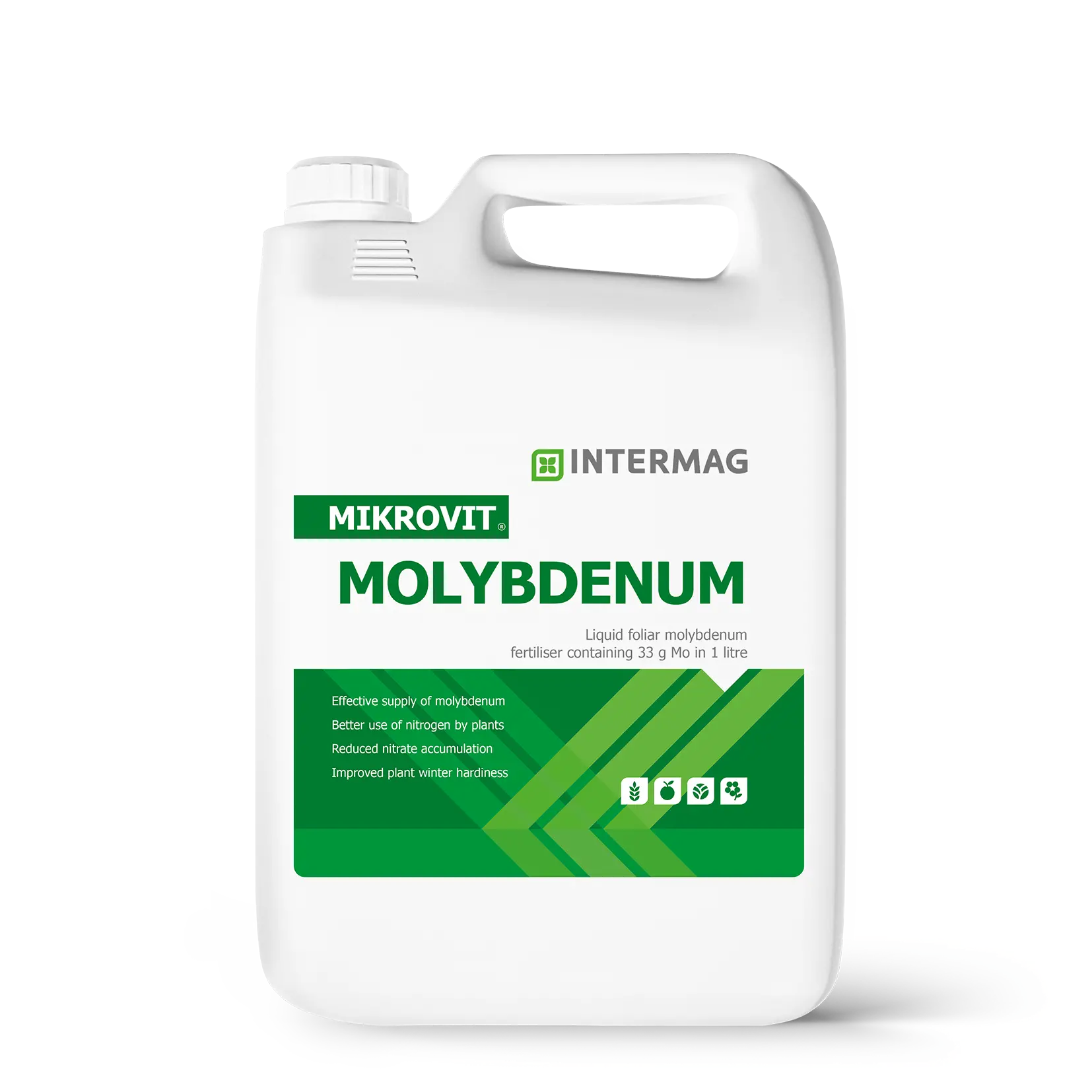
MIKROVIT® MOLYBDENUM is a liquid fertilizer containing 33 g Mo in 1 liter, intended for foliar application. It can also be used to make a nutrient solution for fertigation of crops.
It provides plants with molybdenum, which is quickly and efficiently taken up and used by plants.
| Nutrients | g/L | % (m/m) |
| Molybdenum (Mo) soluble in water, in the form of ammonium salt | 33 | 3.0 |
MIKROVIT® MOLYBDENUM used prophylactically in crops with high requirements for molybdenum (brassica crops, faba bean crops, cereals) – is the most effective source of molybdenum. It is also indispensable when soil conditions exist that limit the availability of this nutrient to plants (low pH, soil water deficiency, low organic matter content).
Used at the times and doses recommended in the fertilization programs of individual species, it effectively prevents the development of molybdenum deficiency in plants.
MIKROVIT® MOLYBDENUM used interventionally effectively eliminates molybdenum deficiency and reduces the negative effects of such periodic deficiency. Intervention feeding is necessary when there are visual symptoms of molybdenum deficiency on plants or when the results of analysis of plant material indicate too low molybdenum content (hidden deficiency).
Molybdenum (Mo) supplied in MIKROVIT® MOLYBDENUM fertilizer has a beneficial effect on yield size and quality, including:
- more efficient utilization of nitrogen taken up by plants in the form of mineral fertilizers
- increasing biomass production and improving yield quality parameters (e.g., higher protein nitrogen content, lower nitrate content)
- supporting the formation of root papillae in legumes – fixing atmospheric nitrogen
- participation in the proper structure of vegetative organs of plants, especially leaves (e.g., prevents the formation of “leaf whip” in cauliflower)
- participation in the preparation of plants for winter dormancy and improvement of winter hardiness of plants
- increase the resistance of plants to stress factors.
|
|
MIKROVIT® MOLYBDENUM is registered for use in organic agriculture in accordance with Regulation (EU) No. 2018/848. |
Directions for Use
- FOLIAR SPRAYS
MIKROVIT® MOLYBDENUM is intended for foliar application in the form of an aqueous solution. MIKROVIT® MOLYBDENUM can be used together with other agrochemicals after conducting a miscibility test.
Detailed recommendations for foliar application are presented in the table below.
- FERTIGATION
Using MIKROVIT® MOLYBDENUM for the preparation of nutrient solution for fertigation – the content of components shall always be adapted to the individual fertilisation recommendations.
Recommended concentration: 0.03–0.06 mg Mo in 1 litre of ready-to-use nutrient solution. (1–2 ml of MIKROVIT® MOLYBDENUM in 1,000 L of ready-to-use nutrient solution or 100–200 ml of fertiliser in 1,000 litres of water when preparing solution of 100-fold concentration).
For soil-grown plants, use 2–3 times during the growing season or every 2–3 cycles of fertigation as required.
Ad. 1. Recommendations for foliar application for selected crops.
The recommendations may be modified taking into account the plants’ requirements and growing conditions.
Additional Information
| Application times for foliar treatments (◆ optimal, ◇ optional): | Direction for use: |
| ◇/◆ leaf development – tillering The application time should be considered as optimal when plants are grown on acidic soils (pH below 6.5), as well as in the case of high nitrogen fertilization. |
Foliar treatments – single dose 0.5–1 L/ha |
| ◇/◆ stem elongation The application time should be considered as optimal when plants are grown on acidic soils (pH below 6.5), as well as in the case of high nitrogen fertilization. |
| Application times for foliar treatments (◆ optimal, ◇ optional): | Direction for use: |
| ◆ Autumn: 3–6 leaves unfolded | Foliar treatments – single dose 0.5–1 L/ha |
| ◇/◆ Spring: continuation of tillering The application time should be considered as optimal when plants are grown on acidic soils (pH below 6.5), as well as in the case of high nitrogen fertilization. |
|
| ◇/◆ stem elongation The application time should be considered as optimal when plants are grown on acidic soils (pH below 6.5), as well as in the case of high nitrogen fertilization. |
| Application times for foliar treatments (◆ optimal, ◇ optional): | Direction for use: |
| ◇/◆ leaf development – tillering The application time should be considered as optimal when plants are grown on acidic soils (pH below 6.5), as well as in the case of high nitrogen fertilization. |
Foliar treatments – single dose 0.5–1 L/ha |
| ◇/◆ stem elongation The application time should be considered as optimal when plants are grown on acidic soils (pH below 6.5), as well as in the case of high nitrogen fertilization. |
| Application times for foliar treatments (◆ optimal, ◇ optional): | Direction for use: |
| ◆Autumn: leaf development – until beginning of tillering | Foliar treatments – single dose 0.5–1 L/ha |
| ◇ Spring: beginning of stem elongation | |
| ◇ flag leaf stage – until first awns visible |
| Application times for foliar treatments (◆ optimal, ◇ optional): | Direction for use: |
| ◇ leaf development – until beginning of stem elongation | Foliar treatments – single dose 0.5–1 L/ha |
| ◇ flag leaf stage – until first awns visible |
| Application times for foliar treatments (◆ optimal, ◇ optional): | Direction for use: |
| ◆ Autumn: leaf development – until beginning of tillering | Foliar treatments – single dose 0.5–1 L/ha |
| ◇ Spring: beginning of stem elongation |
| Application times for foli ar treatments (◆ optimal, ◇ optional): | Direction for use: |
| ◇ leaf development – until beginning of stem elongation | Foliar treatments – single dose 0.5–1 L/ha |
| Application times for foliar treatments (◆ optimal, ◇ optional): | Direction for use: |
| ◇ Autumn: leaf development – until beginning of tillering | Foliar treatments – single dose 0.5–1 L/ha |
| ◇ Spring: beginning of steam elongation | |
| ◇ flag leaf stage – until beginning of heading |
| Application times for foliar treatments (◆ optimal, ◇ optional): | Direction for use: |
| ◇ leaf development – until beginning of steam elongation | Foliar treatments – single dose 0.5–1 L/ha |
| ◇ flag leaf stage – until beginning of heading |
| Application times for foliar treatments (◆ optimal, ◇ optional): | Direction for use: |
| ◇ leaf development – tillering | Foliar treatments – single dose 0.5–1 L/ha |
| ◇ stem elongation – until flag leaf stage |
| Application times for foliar treatments (◆ optimal, ◇ optional): | Direction for use: |
| ◆ Autumn: 4–8 leaves unfolded | Foliar treatments – single dose 0.5–1 L/ha |
| ◇/◆ Spring: beginning of main stem elongation The treatment should be considered as optimal in case of crops grown on acid soils (pH below 6.0) as well as in case of high nitrogen fertilization. |
|
| ◇ bud formation – until beginning of flowering In spring treatments do not exceed a total dose of 1 L/ha. |
| Application times for foliar treatments (◆ optimal, ◇ optional): | Direction for use: |
| ◆ leaf development – until beginning of main stem elongation | Foliar treatments – single dose 0.5–1 L/ha |
| ◇ bud formation – until beginning of flowering In spring treatments do not exceed a total dose of 1 L/ha. |
| Application times for foliar treatments (◆ optimal, ◇ optional): | Direction for use: |
| ◆ 2–3 pairs of leaves (BBCH 14–16) | Foliar treatments – single dose 0.5–1 L/ha |
| ◇/◆ beginning of stem elongation (BBCH 30–35) Consider treatment optimum for cultivation on acidic soils (pH below 6.0), and in the case of high nitrogen fertilisation. |
| Application times for foliar treatments (◆ optimal, ◇ optional): | Direction for use: |
| ◇ leaf development on the main stem (BBCH 14–16) | Foliar treatments – single dose 0.5–1 L/ha |
| ◇/◆ stem growth (BBCH 33–35) Consider treatment optimum for cultivation on acidic soils (pH below 6.0), and in the case of high nitrogen fertilisation. |
| Application times for foliar treatments (◆ optimal, ◇ optional): | Direction for use: |
| ◇ 2–6 leaves unfolded (4 leaves is the optimum stage for treatment) | Foliar treatments – single dose 0.5–1 L/ha |
| ◇/◆ 7–8 leaves unfolded The application time should be considered as optimal when plants are grown on acidic soils (pH below 6.5) and also in the case of high nitrogen fertilisation. |
| Application times for foliar treatments (◆ optimal, ◇ optional): | Direction for use: |
| ◇ beginning of crop cover | Foliar treatments – single dose 0.5–1 L/ha |
| ◇ beginning of storage root development |
| Application times for foliar treatments (◆ optimal, ◇ optional): | Direction for use: |
| ◇/◆ beginning of growth of shoots and leaves (plant height about 10 cm) The treatment should be considered as optimal when plants are grown in soils with pH below 7.0 as well as in light soils. |
Foliar treatments – single dose 0.5–1 L/ha |
| ◇ growth of shoots and leaves (plant height ˃15 cm) |
| Application times for foliar treatments (◆ optimal, ◇ optional): | Direction for use: |
| ◆ first trifoliate leaf development | Foliar treatments – single dose 0.5–1 L/ha |
| ◇ beginning of growth of shoots | |
| ◆ beginning of flower bud development | |
| ◆ beginning of pod and seed development |
| Application times for foliar treatments (◆ optimal, ◇ optional): | Direction for use: |
| ◆ first true leaf development | Foliar treatments – single dose 0.5–1 L/ha |
| ◇ beginning of growth of shoots | |
| ◆ beginning of flower bud development | |
| ◆ beginning of pod and seed development |
| Application times for foliar treatments (◆ optimal, ◇ optional): | Direction for use: |
| ◆ first true leaf development | Foliar treatments – single dose 0.5–1 L/ha |
| ◇ beginning of growth of shoots | |
| ◆ beginning of flower bud development | |
| ◆ beginning of pod and seed development |
| Application times for foliar treatments (◆ optimal, ◇ optional): | Direction for use: |
| ◆ first true leaf development | Foliar treatments – single dose 0.5–1 L/ha |
| ◇ beginning of growth of shoots | |
| ◆ beginning of flower bud development | |
| ◆ beginning of pod and seed development |
| Application times for foliar treatments (◆ optimal, ◇ optional): | Direction for use: |
| ◆ first true leaf development | Foliar treatments – single dose 0.5–1 L/ha |
| ◇ beginning of growth of shoots | |
| ◆ beginning of flower bud development | |
| ◆ beginning of pod and seed development |
| Application times for foliar treatments (◆ optimal, ◇ optional): | Direction for use: |
| ◆ first true leaf development | Foliar treatments – single dose 0.5–1 L/ha |
| ◇ beginning of growth of shoots | |
| ◆ beginning of flower bud development | |
| ◆ beginning of pod and seed development |
| Application times for foliar treatments (◆ optimal, ◇ optional): | Direction for use: |
| ◆ first true leaf development | Foliar treatments – single dose 0.5–1 L/ha |
| ◇ beginning of growth of shoots | |
| ◆ beginning of flower bud development | |
| ◆ beginning of pod and seed development |
| Application times for foliar treatments (◆ optimal, ◇ optional): | Direction for use: |
| ◆ first true leaf development | Foliar treatments – single dose 0.5–1 L/ha |
| ◇ beginning of growth of shoots | |
| ◆ beginning of flower bud development | |
| ◆ beginning of pod and seed development |
| Application times for foliar treatments (◆ optimal, ◇ optional): | Direction for use: |
| ◆ rosette development | Foliar treatments – single dose 0.5–1 L/ha |
| ◇ beginning of growth of shoots | |
| ◆ beginning of flower bud development | |
| ◆ beginning of pod and seed development |
| Application times for foliar treatments (◆ optimal, ◇ optional): | Direction for use: |
| ◆ 6–8 leaves (BBCH 16–18) | Foliar treatments – single dose 0.5–1 L/ha |
| ◇/◆ beginning of stem elongation (BBCH 32–34) Consider treatment optimum for cultivation on acidic soils (pH below 5.5), and in the case of high nitrogen fertilisation. | |
| ◇ stem elongation until beginning of tassel formation (BBCH 37–51) |
| Application times for foliar treatments (◆ optimal, ◇ optional): | Direction for use: |
| ◆ leaf development (BBCH 13–19) | Foliar treatments – single dose 0.5–1 L/ha |
| ◇/◆ beginning of stem elongation (BBCH 32–34) Consider treatment optimum for cultivation on acidic soils (pH below 5.5), and in the case of high nitrogen fertilisation. |
|
| ◇ stem elongation until beginning of tassel development (BBCH 37–51) |
| Application times for foliar treatments (◆ optimal, ◇ optional): | Direction for use: |
| ◆ leaf development – tillering | Foliar treatments – single dose 0.5–1 L/ha |
| ◇/◆ beginning of stem formation The treatment should be considered as optimal when plants are grown on acidic soils and also in the case of a high content of nitrogen (N) in the soil. |
|
| ◇ stem elongation |
| Application times for foliar treatments (◆ optimal, ◇ optional): | Direction for use: |
| ◆ beginning of leaf development | Foliar treatments – single dose 0.5–1 L/ha |
| ◇ beginning of side shoots formation | |
| ◇ beginning of flower bud development |
| Application times for foliar treatments (◆ optimal, ◇ optional): | Direction for use: |
| ◇ green bud stage | Foliar treatments – single dose 0.5–1 L/ha |
| ◇ beginning of fruit development |
| Application times for foliar treatments (◆ optimal, ◇ optional): | Direction for use: |
| ◇ Spring: leaf development | Foliar treatments – single dose 0.5–1 L/ha |
| ◆ Spring/summer: growth of main stem and side shoots |
| Application times for foliar treatments (◆ optimal, ◇ optional): | Direction for use: |
| ◇ 1st year – spring (after plant adaptation in the field): beginning of leaf development | Foliar treatments – single dose 0.5–1 L/ha |
| ◇ 2nd year – spring (after cutting the rootstock above the budding place): beginning of shoot and leaf development | |
| ◆ 2nd year – spring/summer: growth of main stem and side shoots |
| Application times for foliar treatments (◆ optimal, ◇ optional): | Direction for use: |
| ◇ 1st year – spring (after plant adaptation in the field): beginning of shoot and leaf development | Foliar treatments – single dose 0.5–1 L/ha |
| ◇ 2nd year – spring (10–14 days after cutting the main stem at a height of approx. 60–65 cm.): beginning of shoot and leaf development | |
| ◆ 2nd year – spring/summer: growth of main stem and side shoots |
| Application times for foliar treatments (◆ optimal, ◇ optional): | Direction for use: |
| ◇ green bud stage | Foliar treatments – single dose 0.5–1 L/ha |
| ◇ beginning of fruit development |
| Application times for foliar treatments (◆ optimal, ◇ optional): | Direction for use: |
| ◇ end of flowering / beginning of leaf development | Foliar treatments – single dose 0.5–1 L/ha |
| ◇ after harvest |
| Application times for foliar treatments (◆ optimal, ◇ optional): | Direction for use: |
| ◇ end of flowering / beginning of leaf development | Foliar treatments – single dose 0.5–1 L/ha |
| ◇ after harvest |
| Application times for foliar treatments (◆ optimal, ◇ optional): | Direction for use: |
| ◇ end of flowering / beginning of leaf development | Foliar treatments – single dose 0.5–1 L/ha |
| ◇ after harvest |
| Application times for foliar treatments (◆ optimal, ◇ optional): | Direction for use: |
| ◇ end of flowering / beginning of leaf development | Foliar treatments – single dose 0.5–1 L/ha |
| ◇ after harvest |
| Application times for foliar treatments (◆ optimal, ◇ optional): | Direction for use: |
| ◇ end of flowering / beginning of leaf development | Foliar treatments – single dose 0.5–1 L/ha |
| ◇ after harvest |
| Application times for foliar treatments (◆ optimal, ◇ optional): | Direction for use: |
| ◇ end of flowering / beginning of leaf development | Foliar treatments – single dose 0.5–1 L/ha |
| ◇ after harvest |
| Application times for foliar treatments (◆ optimal, ◇ optional): | Direction for use: |
| ◆ growth of shoots | Foliar treatments – single dose 0.5–1 L/ha |
| ◇ beginning of fruit development |
| Application times for foliar treatments (◆ optimal, ◇ optional): | Direction for use: |
| ◆ new shoot development | Foliar treatments – single dose 0.5–1 L/ha |
| ◆ fruit flesh development (beginning of oil production) |
| Application times for foliar treatments (◆ optimal, ◇ optional): | Direction for use: |
| ◆ leaf and shoot development | Foliar treatments – single dose 0.5–1 L/ha |
| ◆ pinhead | |
| ◆ intensive growth of fruit |
| Application times for foliar treatments (◆ optimal, ◇ optional): | Direction for use: |
| ◇ leaf development (BBCH 13–19) | Foliar treatments 0.5–1 L/ha |
| ◇ shoot development, shoots reach 10–70% of final length (BBCH 31–37) | |
| ◇ fruit development, fruits reach 20–70% of final size (BBCH 72–77) |
| Application times for foliar treatments (◆ optimal, ◇ optional): | Direction for use: |
| ◇ leaf development (BBCH 13–19) | Foliar treatments – single dose 0.5–1 L/ha |
| ◇ shoot development, shoots reach 10–70% of final length (BBCH 31–37) | |
| ◇ fruit development, fruits reach 20–70% of final size (BBCH 72–77) |
| Application times for foliar treatments (◆ optimal, ◇ optional): | Direction for use: |
| ◇ leaf development (BBCH 14–19) | Foliar treatments – single dose 0.5–1 L/ha |
| ◆ stem growth (BBCH 33–37) | |
| ◇ fruit development, fruits reach 20–50% of final size (BBCH 72–75) |
| Application times for foliar treatments (◆ optimal, ◇ optional): | Direction for use: |
| ◆ beginning of leaf development and inflorescence emergence | Foliar treatments – single dose 0.5–1 L/ha |
| ◇ fruit development and maturation | |
| ◇ post-harvest |
| Application times for foliar treatments (◆ optimal, ◇ optional): | Direction for use: |
| ◆ beginning of leaf and new shoot development | Foliar treatments – single dose 0.5–1 L/ha |
| ◇ inflorescence emergence | |
| ◇ fruit development – until berries pea-sized |
| Application times for foliar treatments (◆ optimal, ◇ optional): | Direction for use: |
| ◇ leaf and shoot growth | Foliar treatments – single dose 0.5–1 L/ha |
| Application times for foliar treatments (◆ optimal, ◇ optional): | Direction for use: |
| ◇ leaf and shoot growth | Foliar treatments – single dose 0.5–1 L/ha |
| Application times for foliar treatments (◆ optimal, ◇ optional): | Direction for use: |
| ◇ leaf development | Foliar treatments – single dose 0.5–1 L/ha |
| ◇ post-harvest – when plants are leaving for the next growing season |
| Application times for foliar treatments (◆ optimal, ◇ optional): | Direction for use: |
| ◇ leaf development | Foliar treatments – single dose 0.5–1 L/ha. |
| Application times for foliar treatments (◆ optimal, ◇ optional): | Direction for use: |
| ◇ Spring: leaf development | Foliar treatments – single dose 0.5 L/ha |
| ◇ Spring: beginning of runner growth |
| Application times (◆ optimal, ◇ optional): | Direction for use: |
| ◇ FIELD GROWN NURSERY PLANTATIONS – spring: leaf development | Foliar treatments – single dose 0.5 L/ha |
| ◇ FIELD GROWN NURSERY PLANTATIONS – spring: beginning of runner growth |
| Application times for foliar treatments (◆ optimal, ◇ optional): | Direction for use: |
| ◇ Spring: leaf development | Foliar treatments – single dose 0.5 L/ha |
| ◇ Spring: beginning of runner growth |
| Application times for foliar treatments (◆ optimal, ◇ optional): | Direction for use: |
| ◇ leaf and shoot development | Foliar treatments – single dose 0.5–1 L/ha |
| Application times for foliar treatments (◆ optimal, ◇ optional): | Direction for use: |
| ◇ fruit development | Foliar treatments – single dose 0.5–1 L/ha |
| Application times for foliar treatments (◆ optimal, ◇ optional): | Direction for use: |
| ◇ beginning of fruit development | Foliar treatments – single dose 0.5–1 L/ha |
| Application times for foliar treatments (◆ optimal, ◇ optional): | Direction for use: |
| ◇ beginning of fruit development | Foliar treatments – single dose 0.5–1 L/ha |
| Application times for foliar treatments (◆ optimal, ◇ optional): | Direction for use: |
| ◆ 3–6 leaves unfolded | Foliar treatments – single dose 0.5 L/ha |
| ◇ intensive plant growth | |
| ◇ beginning of flowering |
| Application times for foliar treatments (◆ optimal, ◇ optional): | Direction for use: |
| ◆ 3–6 leaves unfolded | Foliar treatments – single dose 0.5 L/ha |
| ◇ intensive plant growth | |
| ◇ beginning of flowering |
| Application times for foliar treatments (◆ optimal, ◇ optional): | Direction for use: |
| ◆ 3–6 leaves unfolded | Foliar treatments – single dose 0.5 L/ha |
| ◇ intensive plant growth | |
| ◇ beginning of flowering |
| Application times for foliar treatments (◆ optimal, ◇ optional): | Direction for use: |
| ◆ 3–6 leaves unfolded | Foliar treatments – single dose 0.5 L/ha |
| ◇ intensive plant growth | |
| ◇ beginning of fruit development | |
| ◇ growth of fruits |
| Application times for foliar treatments (◆ optimal, ◇ optional): | Direction for use: |
| ◆ 3–6 leaves unfolded | Foliar treatments – single dose 0.5 L/ha |
| ◇ intensive plant growth | |
| ◇ beginning of fruit development | |
| ◇ growth of fruits |
| Application times for foliar treatments (◆ optimal, ◇ optional): | Direction for use: |
| ◆ 3–6 leaves unfolded | Foliar treatments – single dose 0.5 L/ha |
| ◇ intensive plant growth | |
| ◇ beginning of fruit development | |
| ◇ growth of fruits |
| Application times for foliar treatments (◆ optimal, ◇ optional): | Direction for use: |
| ◆ 3–6 leaves unfolded | Foliar treatments – single dose 0.5 L/ha |
| ◇ intensive plant growth | |
| ◇ beginning of fruit development | |
| ◇ growth of fruits |
| Application times for foliar treatments (◆ optimal, ◇ optional): | Direction for use: |
| ◆ growth of leaves | Foliar treatments – single dose 0.5–1 L/ha |
| ◇ beginning of onion bulb formation | |
| ◇ bulb of onion reaches 30–50% of the expected size |
| Application times for foliar treatments (◆ optimal, ◇ optional): | Direction for use: |
| ◆ 3rd–5th leaf clearly visible | Foliar treatments – single dose 0.5–1 L/ha |
| ◆ beginning of onion bulb formation | |
| ◇ bulb of onion reaches 30–50% of the expected size |
| Application times for foliar treatments (◆ optimal, ◇ optional): | Direction for use: |
| ◆ growth of leaves – until beginning of onion bulb formation | Foliar treatments – single dose 0.5–1 L/ha |
| Application times for foliar treatments (◆ optimal, ◇ optional): | Direction for use: |
| ◆ 3rd–5th leaf clearly visible | Foliar treatments – single dose 0.5–1 L/ha |
| ◆ beginning of garlic bulb formation | |
| ◇ bulb of garlic reaches 30–50% of the expected size |
| Application times for foliar treatments (◆ optimal, ◇ optional): | Direction for use: |
| ◆ beginning of growth of plants: 1–2 treatments every 7–14 days | Foliar treatments – single dose 0.5–1 L/ha |
| ◇ harvestable plant part reaches 30–50% of the typical size |
| Application times for foliar treatments (◆ optimal, ◇ optional): | Direction for use: |
| ◆ after seedling adaptation to field conditions – leaf development | Foliar treatments – single dose 0.5–1 L/ha |
| ◆ growth of leaves |
| Application times for foliar treatments (◆ optimal, ◇ optional): | Direction for use: |
| ◆ after seedling adaptation to field conditions – leaf development | Foliar treatments – single dose 0.5–1 L/ha |
| ◆ growth of leaves |
| Application times for foliar treatments (◆ optimal, ◇ optional): | Direction for use: |
| ◇ after seedling adaptation to field conditions – leaf development | Foliar treatments – single dose 0.5–1 L/ha |
| ◆ growth of leaves | |
| ◇/◆ beginning of the head formation The application time should be considered as optimal in the case of plant cultivation in acidic soils, as well as in the case of varieties with a long growing season. |
|
| ◇ head reaches approx. 50% of the typical size |
| Application times for foliar treatments (◆ optimal, ◇ optional): | Direction for use: |
| ◇ after seedling adaptation to field conditions – leaf development | Foliar treamtents – single dose 0.5–1 L/ha |
| ◆ growth of leaves | |
| ◇/◆ beginning of the head formation The application time should be considered as optimal in the case of plant cultivation in acidic soils, as well as in the case of varieties with a long growing season. |
|
| ◇ head reaches approx. 50% of the typical size |
| Application times for foliar treatments (◆ optimal, ◇ optional): | Direction for use: |
| ◇ after seedling adaptation to field conditions – leaf development | Foliar treatments – single dose 0.5–1 L/ha |
| ◆ growth of leaves | |
| ◇/◆ beginning of the head formation The application time should be considered as optimal in the case of plant cultivation in acidic soils, as well as in the case of varieties with a long growing season. |
|
| ◇ head reaches approx. 50% of the typical size |
| Application times for foliar treatments (◆ optimal, ◇ optional): | Direction for use: |
| ◇ after seedling adaptation to field conditions – leaf development | Foliar treatments – single dose 0.5–1 L/ha |
| ◆ growth of leaves | |
| ◇/◆ beginning of the head formation The application time should be considered as optimal in the case of plant cultivation in acidic soils, as well as in the case of varieties with a long growing season. |
|
| ◇ head reaches approx. 50% of the typical size |
| Application times for foliar treatments (◆ optimal, ◇ optional): | Direction for use: |
| ◇ after seedling adaptation to field conditions – leaf development | Foliar treatments – single dose 0.5–1 L/ha |
| ◆ growth of the main stem and leaves |
| Application times for foliar treatments (◆ optimal, ◇ optional): | Direction for use: |
| ◆ growth of leaves | Foliar treatments – single dose 0.5–1 L/ha |
| Application times for foliar treatments (◆ optimal, ◇ optional): | Direction for use: |
| ◆ growth of leaves | Foliar treatments – single dose 0.5–1 L/ha |
| Application times for foliar treatments (◆ optimal, ◇ optional): | Direction for use: |
| ◇ after seedling adaptation to field conditions – leaf development | Foliar treatments – single dose 0.5–1 L/ha |
| ◆ growth of the main stem and leaves | |
| ◇ approx. 50% of the leaf mass formed |
| Application times (◆ optimal, ◇ optional): | Direction for use: |
| ◆ growth of leaves: 1–2 treatments every 7–14 days | watering 0.05–0.1% solution spraying 0.25–0.3% solution |
| Application times for foliar treatments (◆ optimal, ◇ optional): | Direction for use: |
| ◆ beginning of storage root formation | Foliar treatments – single dose 0.5–1 L/ha |
| ◆ the storage root reaches about 50% of its typical size |
| Application times for foliar treatments (◆ optimal, ◇ optional): | Direction for use: |
| ◆ beginning of storage root formation | Foliar treatments – single dose 0.5–1 L/ha |
| ◆ the storage root reaches about 50% of its typical size |
| Application times for foliar treatments (◆ optimal, ◇ optional): | Direction for use: |
| ◆ beginning of storage root formation | Foliar treatments – single dose 0.5–1 L/ha |
| ◆ the storage root reaches about 50% of its typical size |
| Application times for foliar treatments (◆ optimal, ◇ optional): | Direction for use: |
| ◆ 7–8 true leaves (BBCH 17–18) | Foliar treatments – single dose 0.5–1 L/ha |
| ◆ root reaches 50–80% of typical diameter (BBCH 45–48) |
| Application times for foliar treatments (◆ optimal, ◇ optional): | Direction for use: |
| ◆ storage root begins to develop, diameter above 2 cm (BBCH 41–43) | Foliar treatments – single dose 0.5–1 L/ha |
| ◆ root reaches 40–70% of typical diameter (BBCH 44–47) |
DISCOVER MORE
VIEW ALL PLANT PRODUCTS →RELATED PRODUCTS
Plant Products
MIKROVIT® BORON TURBO
Liquid, foliar boron fertilizer containing 150 g of Boron in 1L
VIEW DETAILS →
Plant Products
Tytanit
TYTANIT® is a patented growth biostimulant containing TITANIUM (Ti) in a form of unique molecule aTIUM®, what ensures it’s high effectiveness.
VIEW DETAILS →
Plant Products
OPTYSIL
OPTYSIL® is an innovative silicon immunity biostimulant, containing active silicon form, which owes its effectiveness to unique formula duoSIL™
VIEW DETAILS →