
Crop Guides
Professional fertilization and biostimulation programs for specific plant species.

cucumber
CROP DESCRIPTION: cucumber - cultivation in the open field, without fertigationThe cucumber (Cucumis sativus L.) is a member of the Cucurbitaceae family. Cucumbers vary in size and shape depending on the variety.Other popular vegetables from the Cucurbitaceae family are:giant pumpkin (Cucurbita maxima Duch.)field pumpkin (Cucurbita pepo L.), a variety of which is the popular vegetable zucchini/summer squashmelon (Cucumis melo L.),watermelon (Citrullus lanatus).Two methods of growing cucumber are used.GROWN FROM SEEDS SOWN DIRECTLY INTO THE SOILDue to the high heat requirements of cucumbers, sowing should be done when the topsoil temperature is at least 12°C. In spring, plant emergence occurs after 10–14 days under field conditions. At higher temperatures this period is shorter. On the other hand, if the seed is sown too early in soils with lower temperatures, the emergence period will be prolonged. This will expose the seed to disease. There is also an increased risk of young seedlings being damaged by spring frosts. For sowing, use only healthy seeds with a high seed value. It is recommended to treat seeds with the microbial product PRIMSEED BIOM HORTI, which is very beneficial for the growth and initial development of young plants.GROWN FROM SEEDLINGGrowing cucumbers from a seedling is more labor-intensive, but can speed up production by up to 3 weeks compared to growing them from seed.The production of cucumber seedlings for growing in soil or organic substrates is done in pots/multi-pots, as this species is very sensitive to damage to the root system. The substrate should be sterile, sufficiently porous and rich in nutrients, with a pH of 6.0-6.5. During the early stages of seedling growth, it is very beneficial to use the microbial product BACTIM® RADINET for better development of the plant root system. During the development and growth of true leaves – it is recommended to fertilize the seedlings with a solution of PLONVIT®OPTY multi-nutrient fertilizer and PLONVIT® CALCIUM TURBO. The seedling production period lasts 3 weeks. A well grown seedling should be stocky with two well developed leaves and a well grown root ball. In the last days before planting (3–4 days) it is recommended to harden the seedlings. Cucumber has high soil requirements. It thrives best in soils that are well structured, rich in organic matter, warm and permeable. Because of its shallow root system, cucumber has a high fertilizer requirement. It responds very favorably to organic fertilization. It also requires intensive and rational mineral fertilization, adapted to the needs and the richness of the soil, determined by soil analysis.Apart from basic soil fertilization, foliar fertilization is a standard. Its main advantage fertilization is the quick and effective supply of the most-required nutrients to plants at particular stages of development.Presently, foliar treatments are an integral part of the mineral nutrition programs for cucumber, because:Support supplying plants with major nutrients:nitrogen (N) – PLONVIT® NITROMAG or PLONVIT® NITROphosphorus (P) – GROWON® or PLONVIT® FOSTAR or PLONVIT® PHOSPHOpotassium (K) – PLONVIT® KALPRIM or PLONVIT® KALI magnesium (Mg) – MIKROKOMPLEX®sulphur (S) – PLONVIT® SULVIT or PLONVIT®BOROSULF.Support supplying cucamber with calcium (Ca), which is a low-mobility nutrient in the plant – OPTYCAL, PLONVIT® CALCIUM TURBO.In terms of micronutrients, foliar fertilization is the primary and the most effective way of providing them to plants:boron (B) – MIKROVIT® BORONTURBO or MIKROVIT® BORONcopper (Cu) – AMINO ULTRA® Cu 24 or MIKROCHELAT™ Cu-15iron (Fe) – AMINO ULTRA®Fe-20 or MIKROCHELAT Fe-13manganese (Mn) – AMINO ULTRA® Mn-22 or MIKROCHELAT™ Mn-13molybdenum (Mo) – MIKROVIT® MOLYBDENUMzinc (Zn) – AMINO ULTRA® Zn-24 or MIKROCHELAT™ Zn-15.High yielding of cucumber plants and a long harvest time also require supporting of plant growth and tolerance to stresses which could ensure yield quantity and good quality.The foliar applications of TYTANIT®, OPTYSIL®, AMINOPRIM®, PLANTICINE® may stimulate plants for better growth and yield and for improvement of tolerance to abiotic (weather conditions) and biotic (disease and pest appearance) stresses, as well as the capability of accelerating the recovery of plants after the occurrence of stressful conditions.Particularly noteworthy are the highly alkaline line of fertilizers ALKALIN™: ALKALIN™ K+Si, ALKALIN™ KB+Si, ALKALIN™ PK 10:20. Alkaline pH of fertilizer solutions activates the immune factors of plants.The formation of a strong root system is essential for the correct development of the plant, since in cucumbers there is a very large disproportion between the above-ground part and the roots. The use of BACTIM® TERRASTART, BACTIM® VIGOR – increases the microbial biodiversity of the soil, stimulates the development of the root system and its regeneration, accelerates the mineralization and humification of organic matter, improves the structure of the soil and its physical and chemical properties, and reduces the development of soil-borne fungal diseases.INTERMAG’s wide range of products allows you to design your own individual foliar fertilisation and biostimulation programme, taking into account local soil conditions, cropping intensity, crop development stage and product availability.

WHEAT – SPRING WHEAT
CROP DESCRIPTION: WHEAT – SPRING WHEATSpring cereal crops, compared to winter forms, are characterized by a shorter growing season, lower yield potential and greater sensitivity to unfavorable weather conditions.SPRING WHEAT(Triticum aestivum L.) is grown mostly for production of quality flour.It requires a good supply of not only with nitrogen, but also with phosphorus, potassium, magnesium, sulfur, copper and manganese. These elements improve use of nitrogen which results in increased yield and improvement of grain parameters quality. Well-fed plants are also more resistant to stress factors.One of the important elements of correct agricultural technology of spring wheat growing is sowing as early as possible.The main goal is to extend the period of vegetative growth until the plants switch to the generative phase, which takes place as the day gets longer. Root system growth and tillers development at this period will impact further plant development and yield.A well-developed root system allows plants to efficiently uptake water and nutrients from the soil.For intensive development of the root system, it is necessary to provide plants with phosphorus (P). The uptake of phosphorus from the soil in early spring may be limited – it is possible only when the soil temperature is above 12°C. In such conditions foliar feeding of plants with phosphorus, using such products as: GROWON® or PLONVIT® FOSTAR or PLONVIT® PHOSPHO – is very beneficial for the development of young plants. The ROOTSTAR™ activator can also be used for intensification of root system development.Nitrogen (N) is important for the tillering process. Spring cereals require entire dose (or the first its part) of nitrogen to be applied to the soil before sowing. In order to increase nitrogen uptake and its yield forming efficiency, the availability of other macro- and microelements for plants is also necessary. The foliar application of phosphorus (P), potassium (K) and micronutrients is very beneficial for the tillering process (PLONVIT® OPTY, PLONVIT® UNI PK 10:20, PLONVIT® CEREALS). Of all the microelements, copper (Cu) is particularly important at that time, the sources of which are proven in practice fertilizers: AMINO ULTRA® Cu-24, MIKROCHELAT™ Cu-15 or MIKROVIT® COPPER.The tillering growth phase ends with the beginning of the stem elongation. Foliar feeding in the initial stage of stem elongation is aimed at intensifying growth of biomass and to create conditions for good development of leaves, especially the flag leaf and sub-flag leaf. During that period, a comprehensive feeding of plants with macro- and micronutrients is recommended – PLONVIT® OPTY, PLONVIT® CEREALS. Among the all micronutrients, manganese (Mn) is of particular importance at this time, the sources of which are proven in practice fertilizers: AMINO ULTRA® Mn-22 or MIKROCHELAT™ Mn-13 or MIKROVIT® MANGANESE.In the next stages of crop formation (heading, flowering, fertilization, kernel development and maturation), it is important to perform treatments focused on keeping the flag and sub-flag leaves in good condition. This has a positive effect on the transport of assimilates to kernels, which increases the quantity and quality of the yield.It is also very important to support proper water management in the plant (especially during periods of water shortage), by foliar plant feeding with potassium (K) – PLONVIT® UNI PK 10:20, PLONVIT® KALPRIM or PLONVIT® KALI.The good condition of plants throughout the growing season determines the wheat yield.Even short-term nutrient deficiency may have a negative impact on plant growth and yield. Therefore, it is necessary comprehensive assessment of the requirements of the plants at any stage of their development. This will allow them to be properly fed and biostimulated.INTERMAG’s wide range of products, allows you to develop your own individual foliar fertilization and biostimulation program, considering local soil conditions, crop intensity, stage of plant development and availability of various products.Particularly noteworthy is fertilizer ALKALIN™, which, in addition to the basic functions of bringing in nutrients, has shielding properties for plants: ALKALIN™ PK 10:20.All these presented actions significantly affect the yield increase and its quality parameters.
الخيار
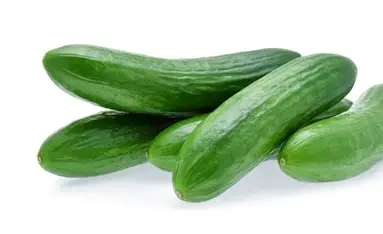
CROP DESCRIPTION: cucumber - cultivation in the open field, without fertigationThe cucumber (Cucumis sativus L.) is a member of the Cucurbitaceae family. Cucumbers vary in size and shape depending on the variety.Other popular vegetables from the Cucurbitaceae family are:giant pumpkin (Cucurbita maxima Duch.)field pumpkin (Cucurbita pepo L.), a variety of which is the popular vegetable zucchini/summer squashmelon (Cucumis melo L.),watermelon (Citrullus lanatus).Two methods of growing cucumber are used.GROWN FROM SEEDS SOWN DIRECTLY INTO THE SOILDue to the high heat requirements of cucumbers, sowing should be done when the topsoil temperature is at least 12°C. In spring, plant emergence occurs after 10–14 days under field conditions. At higher temperatures this period is shorter. On the other hand, if the seed is sown too early in soils with lower temperatures, the emergence period will be prolonged. This will expose the seed to disease. There is also an increased risk of young seedlings being damaged by spring frosts. For sowing, use only healthy seeds with a high seed value. It is recommended to treat seeds with the microbial product PRIMSEED BIOM HORTI, which is very beneficial for the growth and initial development of young plants.GROWN FROM SEEDLINGGrowing cucumbers from a seedling is more labor-intensive, but can speed up production by up to 3 weeks compared to growing them from seed.The production of cucumber seedlings for growing in soil or organic substrates is done in pots/multi-pots, as this species is very sensitive to damage to the root system. The substrate should be sterile, sufficiently porous and rich in nutrients, with a pH of 6.0-6.5. During the early stages of seedling growth, it is very beneficial to use the microbial product BACTIM® RADINET for better development of the plant root system. During the development and growth of true leaves – it is recommended to fertilize the seedlings with a solution of PLONVIT®OPTY multi-nutrient fertilizer and PLONVIT® CALCIUM TURBO. The seedling production period lasts 3 weeks. A well grown seedling should be stocky with two well developed leaves and a well grown root ball. In the last days before planting (3–4 days) it is recommended to harden the seedlings. Cucumber has high soil requirements. It thrives best in soils that are well structured, rich in organic matter, warm and permeable. Because of its shallow root system, cucumber has a high fertilizer requirement. It responds very favorably to organic fertilization. It also requires intensive and rational mineral fertilization, adapted to the needs and the richness of the soil, determined by soil analysis.Apart from basic soil fertilization, foliar fertilization is a standard. Its main advantage fertilization is the quick and effective supply of the most-required nutrients to plants at particular stages of development.Presently, foliar treatments are an integral part of the mineral nutrition programs for cucumber, because:Support supplying plants with major nutrients:nitrogen (N) – PLONVIT® NITROMAG or PLONVIT® NITROphosphorus (P) – GROWON® or PLONVIT® FOSTAR or PLONVIT® PHOSPHOpotassium (K) – PLONVIT® KALPRIM or PLONVIT® KALI magnesium (Mg) – MIKROKOMPLEX®sulphur (S) – PLONVIT® SULVIT or PLONVIT®BOROSULF.Support supplying cucamber with calcium (Ca), which is a low-mobility nutrient in the plant – OPTYCAL, PLONVIT® CALCIUM TURBO.In terms of micronutrients, foliar fertilization is the primary and the most effective way of providing them to plants:boron (B) – MIKROVIT® BORONTURBO or MIKROVIT® BORONcopper (Cu) – AMINO ULTRA® Cu 24 or MIKROCHELAT™ Cu-15iron (Fe) – AMINO ULTRA®Fe-20 or MIKROCHELAT Fe-13manganese (Mn) – AMINO ULTRA® Mn-22 or MIKROCHELAT™ Mn-13molybdenum (Mo) – MIKROVIT® MOLYBDENUMzinc (Zn) – AMINO ULTRA® Zn-24 or MIKROCHELAT™ Zn-15.High yielding of cucumber plants and a long harvest time also require supporting of plant growth and tolerance to stresses which could ensure yield quantity and good quality.The foliar applications of TYTANIT®, OPTYSIL®, AMINOPRIM®, PLANTICINE® may stimulate plants for better growth and yield and for improvement of tolerance to abiotic (weather conditions) and biotic (disease and pest appearance) stresses, as well as the capability of accelerating the recovery of plants after the occurrence of stressful conditions.Particularly noteworthy are the highly alkaline line of fertilizers ALKALIN™: ALKALIN™ K+Si, ALKALIN™ KB+Si, ALKALIN™ PK 10:20. Alkaline pH of fertilizer solutions activates the immune factors of plants.The formation of a strong root system is essential for the correct development of the plant, since in cucumbers there is a very large disproportion between the above-ground part and the roots. The use of BACTIM® TERRASTART, BACTIM® VIGOR – increases the microbial biodiversity of the soil, stimulates the development of the root system and its regeneration, accelerates the mineralization and humification of organic matter, improves the structure of the soil and its physical and chemical properties, and reduces the development of soil-borne fungal diseases.INTERMAG’s wide range of products allows you to design your own individual foliar fertilisation and biostimulation programme, taking into account local soil conditions, cropping intensity, crop development stage and product availability.
Need a custom program?
Our agronomists are ready to prepare a personalized fertilization program adjusted to your local soil conditions and specific crop varieties.
Consult an Expert